
When people talk about financial inclusion, the focus is often on credit. But for many women in Liberia, the difference between moving forward and falling back is not access to a loan. It is the ability to save, manage shocks and rely on peers when life becomes unpredictable.
This is why our Women’s Club invests as much effort in savings and peer-to-peer support as it does in microloans.
Savings as a foundation, not an afterthought
In 2025, 128 of our 271 Women’s Club members actively participated in the Savings Club, together saving a total of USD 5 233. Monthly saved amounts are often small, usually ranging from USD 3 to USD 50.
However, the emphasis is not on how much women save, but on building the habit. Regular saving helps members plan ahead, smooth household expenses and avoid using business capital to cover emergencies. Over time, this reduces pressure on income-generating activities and strengthens overall financial stability.
Peer-to-peer lending for life’s realities
The members of the Savings Club also give peer-to-peer loans to each other. In 2025, members issued 70 loans to one another, with a total value of USD 3 947. These loans are typically used for school fees, healthcare, funeral costs or other urgent household needs.
We deliberately distinguish between microloans and peer-to-peer (P2P) lending.
Microloans come from our microloan fund and are intended for business activities that generate additional income. AKA income-generating activities.
The fund is revolving. This means that the capital remains intact: women repay their loans with interest, allowing us to lend the money again to other women.
P2P loans are designed to cushion financial shocks that could otherwise disrupt a woman’s life. These loans are also repaid with interest. At the end of the year, the interest is distributed among all savers.
Most women do not have a bank account, which means this is often their first experience of how interest can help their money grow. And that often leaves them wanting more!
By separating these functions, the Women’s Club protects both livelihoods and repayment discipline. (And yes, we also teach women about the importance of not overextending themselves financially.)
Trust as financial infrastructure
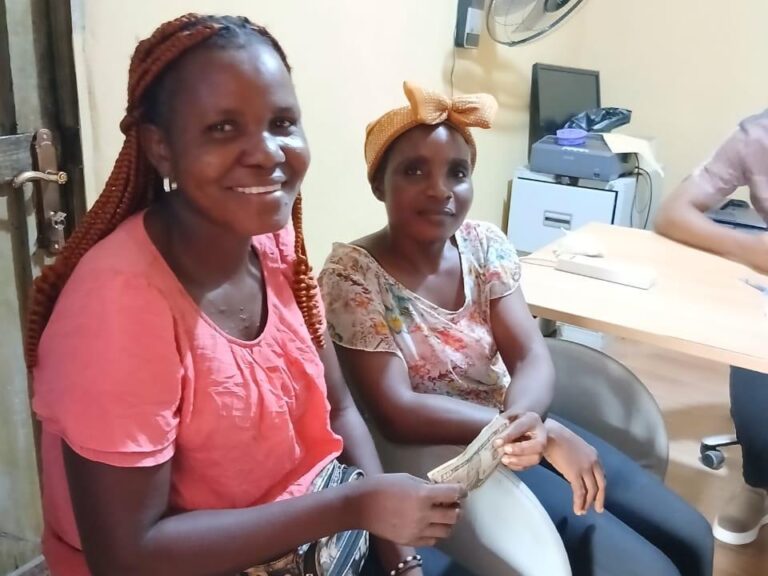
Our Savings Club and the peer lending work because they are embedded in strong social structures. Women save together, lend money to the people they save with, and hold one another accountable. The elected leaders of the Women’s Club play an important role in this: they guide discussions, monitor commitments and intervene early if problems arise.
In addition, the women meet at least once a month and know what’s going on in each other’s lives. There is mutual trust, and we ensure that this trust is reinforced through professional structures.
This trust-based system reduces risks, for the women and for us. It enables us to provide microloans without requiring collateral. At the same time, it strengthens solidarity: women know they don’t have to go it alone when life becomes difficult.
Why this matters
Saving together, P2P lending, supporting one another… it may seem small compared to providing microloans, but these activities are what make the Women’s Club impactful. Without this mutual trust, our impact would be far more limited.
It also builds resilience: the ability to absorb setbacks without losing everything that has been built up.
The integrated approach of the Women’s Club ensures that women have access to multiple financial tools: income, savings, social support and practical guidance.
The result is both business growth and greater stability. For the women themselves, for their families and for their communities.